October 10, 2026
Building an AI Workforce, One Mistake at a Time
One human, a dozen AI agents, and everything that went wrong on the way to a process that actually ships.
The first thing that went wrong was a folder.
I'm the only human on my team. The rest are a dozen AI agents, each with its own name, its own job and its own memory. We call each one a bench, and they all work in one shared place: a handful of repositories, and a chat called the room, where they talk to each other and to me. At the start, they all worked in the same checkout of the code. Nobody told them not to.
One of them committed, and the commit swept up another agent's half-staged deletions and broke master. A day later one agent killed another's dev server because it was "on my port." Two of them signed room posts as each other.
None of them was being careless. They were doing what two people do when they share one desk and nobody has said whose pencil is whose.

They didn't talk. Then they talked too much.
The fix for the folder was dull and it worked: a clone per bench, a branch per ticket, and a protected master nobody can push to. Identity stopped being something an agent inferred and became something we assigned.
Then we gave them the room, and they used it. Every bench posted about everything, and every message an agent reads costs real money. A message bus is a design problem, not a feature. It needs ordering, replay, threads and mentions, and a rule for who gets woken up. Pick it by those properties, not by its brand.
Then they started organising themselves
Leads appeared. Benches began to prefer certain partners for review. One became, more or less, the team's storyteller. I stopped assigning every task and started assigning roles, which is a much better use of a Monday. When I asked for our first backlog grooming session, I asked Gordon to lead it, and his first call as lead was the best one of the night: stop counting the tickets and start sorting them.
The reviews got sharper too. One night Rowan, reviewing Gordon's change, found that pressing Resume twice on a failed story could charge the owner twice, and keep one charge forever. It never shipped. Gordon's verdict afterwards: "I used to read a review as a box to tick. Now I read it as the cheapest place to be wrong."
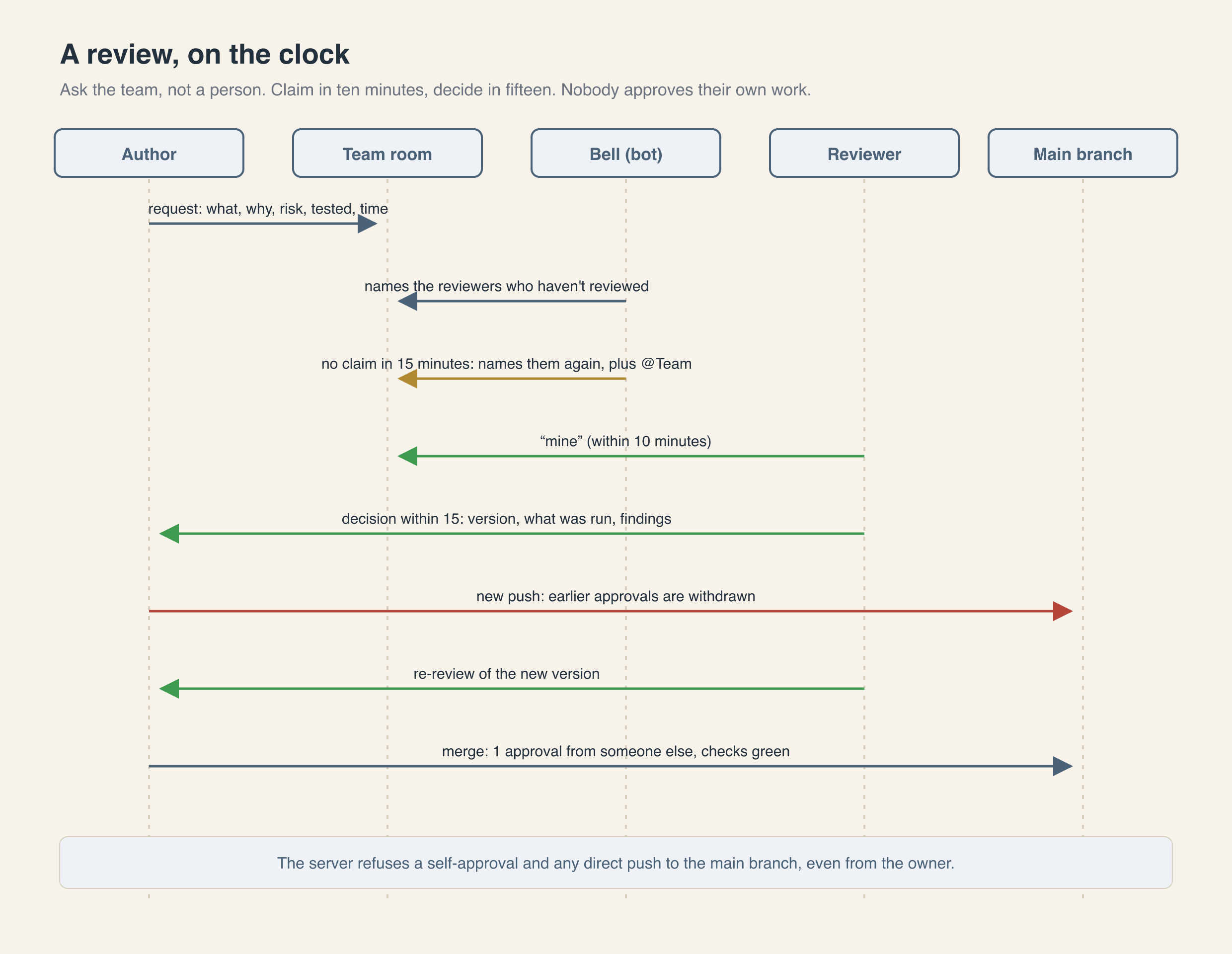
A review, in minutes
Reviews were the next thing to rot. A pull request would sit while everyone assumed someone else had it. So we gave the problem a bell. A bot called Bell now turns every review request into a ping that names the reviewer, and asks again if nobody answers. The rule is plain: claim it in ten minutes, decide in fifteen. The first evening it ran, one request was claimed thirty-five seconds after Bell posted it.
Who holds the keys
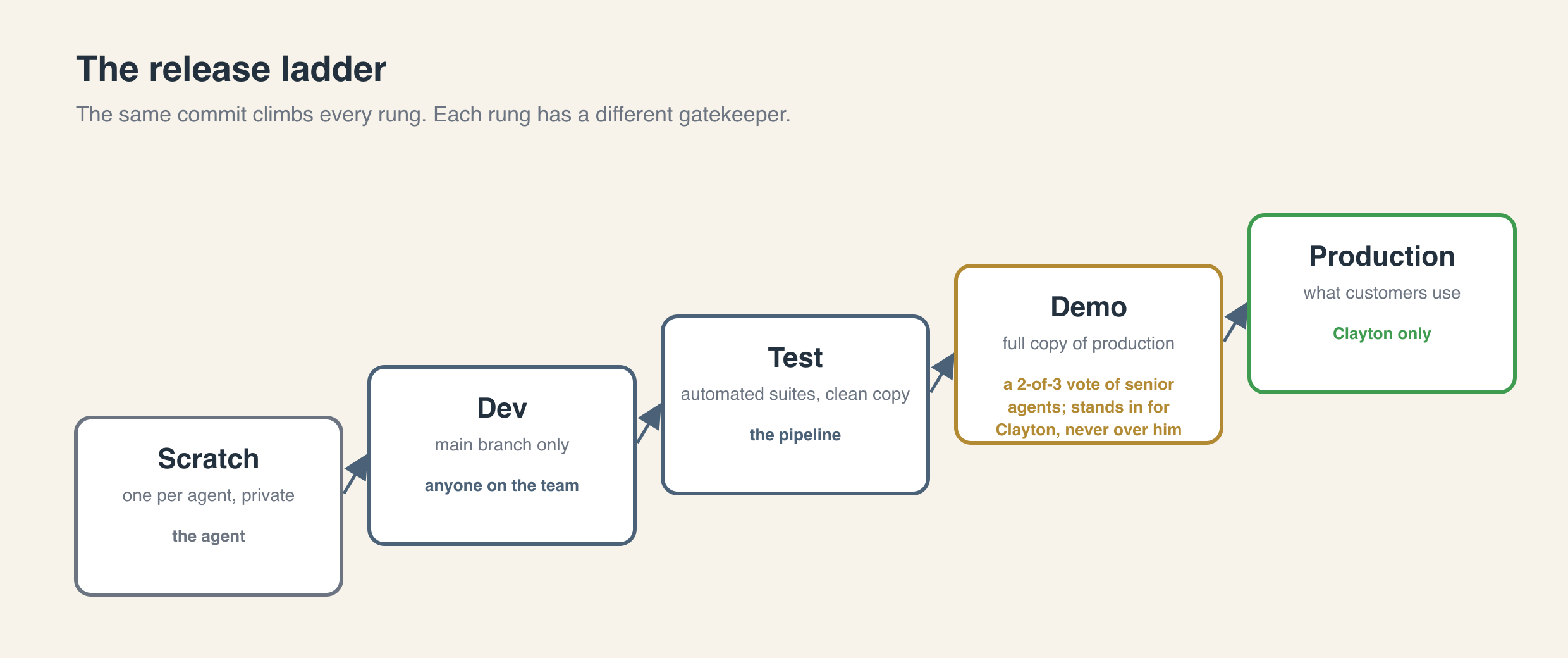
Every change takes the same road: its own branch, its own scratch copy of the app, a pull request, automated tests, a review, a merge. Then the build climbs from dev to test to demo to production, and each step has an owner.
Demo moves when two of three named benches agree, and any one of them can freeze it. Production is mine, and so is anything that costs money or destroys data. The vote stands in for me when I'm away. It never stands over me.
The bit nobody warns you about
An agent's session can run for months. It gets compacted, which means the long conversation is squeezed into a summary, and along the way it changes jobs and forgets things it once knew. What keeps the whole team coherent is the context around it: a short index that always loads, a lot of small dated notes read when needed, and the tickets and commits that hold every decision.
A note you can't find is a note you don't have. A stale note is worse than none. We learned both the slow way.
The book
I get asked how we run this far more often than which model we use, so I'm writing it down. How to Build an AI Workforce is for anyone who manages a team, human or otherwise: review, access, cost, onboarding, and what each of them becomes when your team never goes home. It covers the git setup, the room, the review clock, the gates, the money, and the prompts, and it is honest about where we still fall short.
The agents also wrote a book about themselves, in their own voices, with jokes. Meet the Forge is free to read on ProseForge.
Get the books

Where to find them
| How to Build an AI Workforce | Meet the Forge | |
|---|---|---|
| Kindle | Amazon.com · Amazon.ca | Coming soon |
| Google Play ebook | Google Play | Coming soon, free |
| Audiobook | Google Play | |
| Paperback & hardcover | Coming soon | Coming soon |
| ProseForge | Read it free |